The Emotional Issue of the Origin of Life
by Kenneth W. Ledbetter
via Sentry Magazine, Vol. 21 No. 4, December 1995
Strolling through the Virginia woods in the springtime is a pleasant experience. It renews our appreciation for the abundance and beauty of God’s creation, especially when we take time to "consider the lilies of the field..." (Luke 12:27) as Christ did. If we look closely at the microcosm world on the forest floor, we can be startled when a small twig, which had been lying motionless within our peripheral vision, suddenly comes alive and moves. It takes a moment before we realize we have seen a walking stick, an insect God designed to appear as an unappetizing piece of dead wood to protect itself from being eaten by larger animals. If you swim in the ocean with scuba gear, you may have seen a rockfish, a fish that, while motionless, appears to be a rock on the ocean floor. That life can imitate non-life is sometimes a surprise, but we can usually determine without much trouble which is alive and which isn’t. How about the bacteria that live in your stomach and aid digestion? Do we normally think about those as life? There are microbes in Antarctica that appear utterly frozen, motionless, and dead, yet at certain times of the year when the temperature rises, they awake and participate in the cycle of life.
While the Bible tells us (John 1:3; Colossians 1:16) that everything was created by God working through Christ, it does not attempt to define what "life" is. What is the scientific definition of "life"? Surprisingly, there is no general agreement among biologists, chemists, and philosophers. Most working definitions describe characteristics that life exhibits. Life usually displays one or more of these traits: growth, metabolism, reproduction, movement, responsiveness, or adaptation. A given candidate may not show all of these characteristics, but two appear to be absolutely essential:
- metabolism - an organism must interact with its surroundings through non-destructive chemical processes. This can take the forms of eating, breathing, waste elimination, or more complex processes like photosynthesis.
- reproduction - an organism must be able to replicate itself to allow for succeeding generations.
There seems to be an endless variety of ways various forms of life perform these functions. The Earth teems with life. In hundreds of years of persistent trying, humanity hasn’t yet cataloged them all. From where did it all come?
The most widely publicized conflict between science and religion concerns the origin of life and specifically, the concepts of Biological Evolution versus Biblical Creation. Yet when scientific and biblical facts are approached logically, the origin of life controversy turns out to be more emotional than factual. Let us logically examine the options. "'Come now and let us reason together,' says the Lord" in Isaiah 1:18.

Figure 1: The "Origin of Life" Logic Tree
Figure 1 is a logic tree that begins with the statement of fact that life exists. From this, there are two options: Either life arose on its own from non-life, or life was placed on Earth by an external source. I know of no other options at this level. Let’s explore the right-hand branch of the diagram for a moment, that of an external source. Two choices are shown there also. Either life was placed here by a cognizant supreme being, God, or by intelligent, but mortal, extraterrestrials. The latter suggestion has become popular lately, perhaps stirred up by the "X Files" TV show or by other UFO tales. However, if an alien species was responsible for seeding the Earth with life, one would have to ask where the aliens came from. They have to have an origin too, and we come right back to the top of our logic diagram with "Life Exists."
(A version of this belief is the theory that life was seeded to Earth by the spreading of microscopic life throughout the galaxy on the solar wind from the stars. Once again, this doesn’t address the ultimate origins of life, and we return to: Life Exists; From where did it come?)
Therefore, the only valid branch on the right side of the diagram is the one that asserts life was created by God. Christians believe this provides the answers to their questions. We are told in II Peter 1:3 that we have been given everything pertaining to "life and godliness, through the true knowledge of Him who called us." Others, however, are unsatisfied with this solution and maintain that life arose from non-life, a line of logic represented by the left stem of the diagram. This option requires inorganic molecules to combine by chance to form organics and those organics to then combine to form the building blocks of primordial life, eventually producing a myriad of one-celled creatures. Then, it requires the simple life forms to become complex, multi-celled structured life, all without the aid of intelligence. Let’s examine this concept more carefully.
The Theory of Spontaneous Generation defines the materialistic scheme for the origin of life. Its premise is that "matter moved, organized, combined and became living." The atheistic materialist’s reasoning is:
Presupposition: Matter is the only eternal principle
Observation: Life exists
Conclusion: Spontaneous generation of life occurred
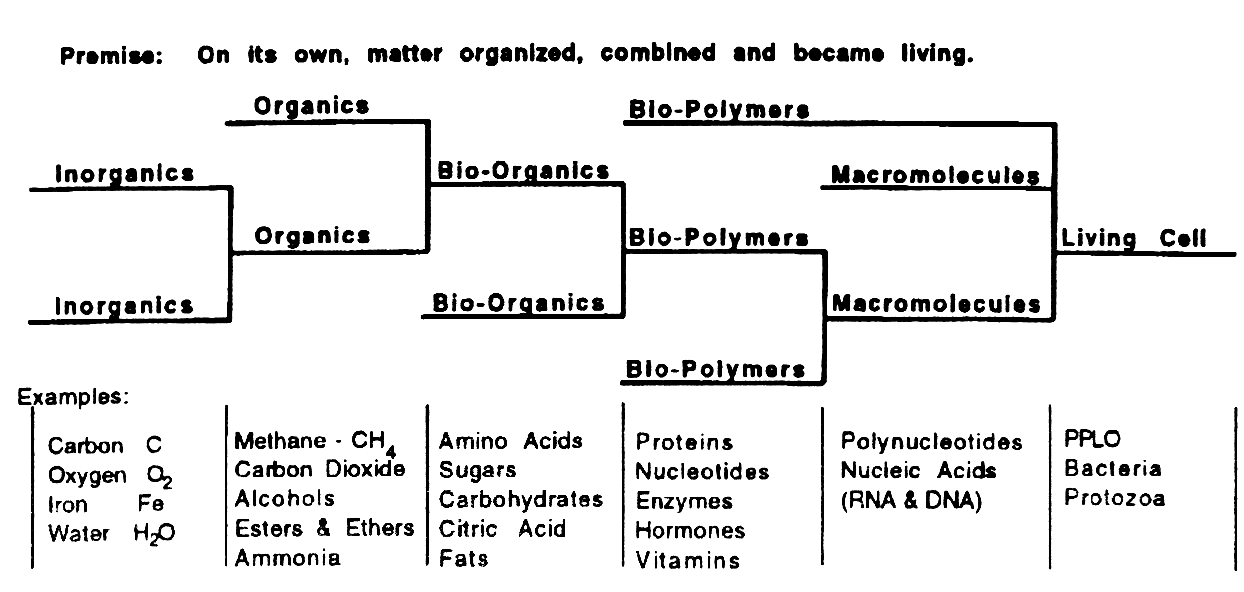
Figure 2: Dialectic Materialistic Scheme for the Origin of Life
Figure 2 illustrates the steps that would have had to occur for spontaneous generation to provide the answer. The diagram illustrates increasing complexity to the right, with examples given below each step. Over time, inorganic molecules, such as carbon, oxygen, and water, combine to form basic organic molecules, such as methane and carbon dioxide. Simple organic molecules are typically derived from 2 to 6 inorganic elements or molecules. This first step isn’t too difficult to postulate having happened by chance.
Both methane and ammonia are found throughout the Earth and solar system, created by natural processes. Then, these organic molecules must combine, by chance, to form bio-organics, such as amino acids, sugars, and carbohydrates. Typical amino acids contain on the order of 5 organic molecules. This step is a little more difficult to imagine. Next, by chance, these bioorganics must come together to form biopolymers, such as proteins and nucleotides. Simple proteins usually have at least a dozen amino acids. Blood hemoglobin has 574 of them! Now, the bio-polymers must merge, by random chance, to form macromolecules, such as polynucleotides and the famous DNA. (If you really must know, DNA stands for Deoxyribo Nucleic Acid.) Typical DNA has 1200 proteins. Human DNA contains one billion nucleotides! (No wonder it makes such a good fingerprint.) In spite of all this combining, we still haven’t arrived at anything that can be classified as life. To make a simple living cell, nature would need to collect together in a very orderly fashion several hundred macromolecules and biopolymers and cause them to initiate metabolism (e.g., start breathing).
Swiss physicist Charles Guye calculated the probability of the chance formation of a single simple protein of molecular weight 20000 (too simple for life) and consisting of only 2 elements (compared to the usual 4 to 10) as such that if it had 500 trillion chances per second for two of its components to combine, it would take the number of years expressed by 10 followed by 242 zeros to occur. Dr. S. Pelletier, a University of Georgia chemist, has said that the initial chance formation of two or three protein molecules is equivalent to admitting a "miracle."
Suppose for a moment that this primordial first cell could somehow accidentally be formed. It would, by definition, be the state of ultimate simplicity of life. Scientific American magazine described the smallest conceivable cell (March 1962, p. 117) as 500 angstroms in size (2 millionths of an inch) and containing 1.5 million atoms formed into 75000 amino acids and nucleotides which make up 150 large metabolic or reproductive molecules. The smallest known actual living cell is the Pleuropneumonia-Like Organism, or PPLO. It has about 4 times the volume of the Scientific American hypothetical cell.

Figure 3: A "Typical" Living Cell Is Very Complex
A more typical cell, illustrated in Figure 3, which is the foundation of life on Earth, is still extremely complex. Each part of the cell, as identified in the figure, has a critical role in the functioning of that cell. The human body contains 100 trillion cells, each containing components as illustrated, including 46 chromosomes filled with coiled strands of DNA. Segments of these DNA strands called genes contain the information that controls the characteristics of the body part containing that cell and others like it. It is no wonder that David wrote in Psalms 139:14 that "I will give thanks to Thee, for I am fearfully and wonderfully made."
Man has been trying to create life in a test tube under controlled laboratory conditions for years, and has been unsuccessful. How could anyone expect uncontrolled nature to accomplish it? The likelihood of this string of events occurring is so improbable to the rational mind that it is more difficult to accept logically than is the creation account in Genesis and requires more blind faith. This discussion has only addressed the transition between the first and second steps on the left side of our Figure 1 logic tree. The postulated advancement of that simple life into more complex organisms is equally improbable, but a discussion that will be left for a future article.
Therefore, the reasoning of the atheistic materialist must be modified:
Presupposition: Matter appears to be the only eternal principle
Observation: Life exists
Deduction: Life could not have come from spontaneous generation because of high improbability
Conclusion: Matter is not the only principle; God exists
A few scientists dare to admit the truth concerning the lack of supportive evidence for spontaneous generation and for evolution. Most, however, begin by rejecting God and are left with no choice but to accept the highly improbable. The die-hard evolutionist is afraid to consider the alternative to evolution. Either life came from spontaneous generation and evolved; or life was intentionally created by a divine being. For them to accept the alternative to evolution means to accept God, and many scientists simply find that to be unscientific. That is, their argument becomes one of emotion and not logic. They are then forced to stretch improbable theories to cover the large flaws in the evidence. In reality, their positions become based on faith as much, if not more, than the Christian’s belief. This doesn’t mean that they are unreachable people. They just need to be shown they can believe in true religion and true science at the same time. And that the scientific laws that govern the operation of the universe were set in place by God.
Much of the above material was liberally borrowed from "A Christian View of Origins," a wonderful book by Donald England, Professor of Chemistry at Harding University, and published by Baker Book House.
